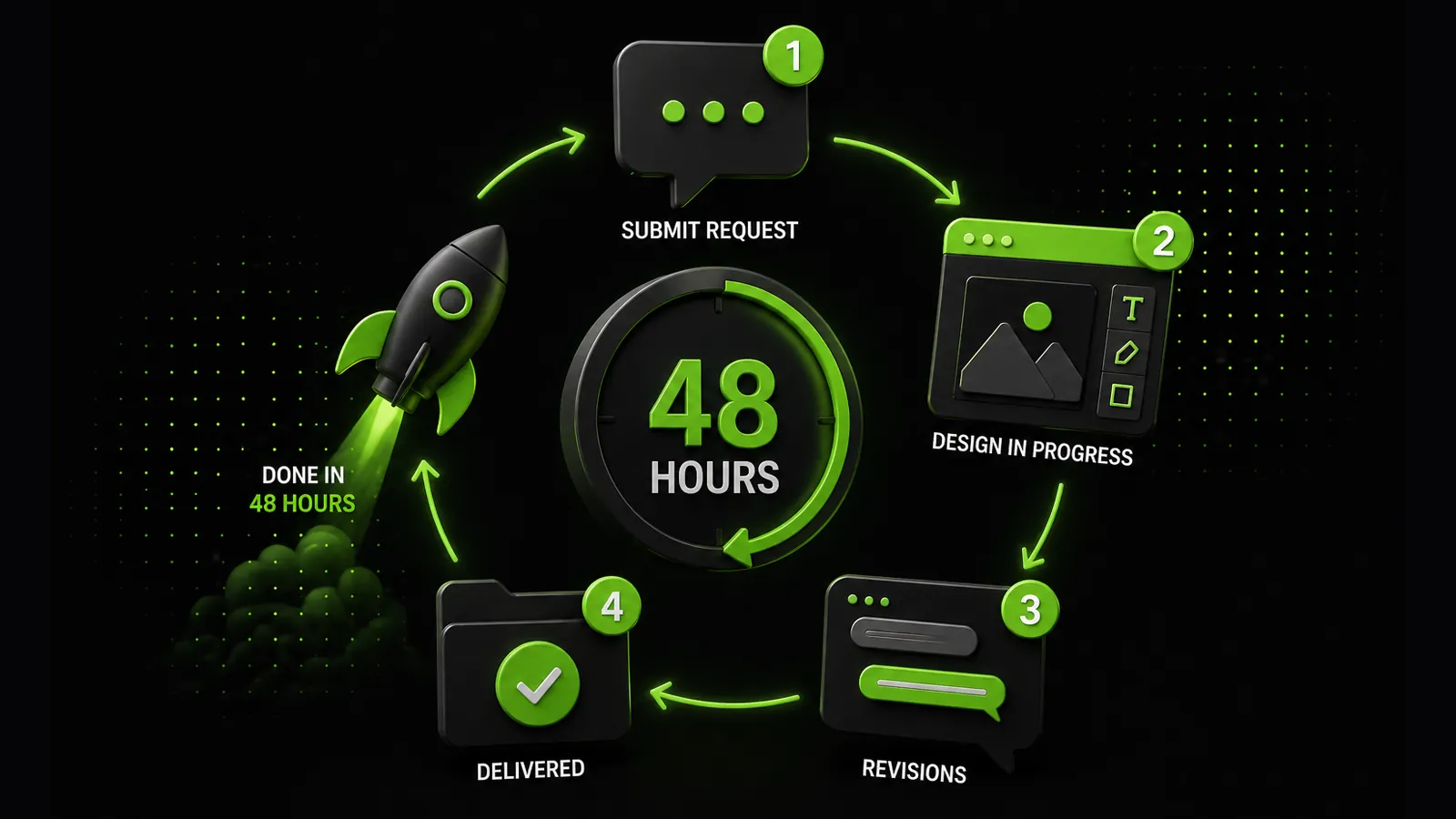
A graphic design subscription that promises 48-hour delivery lives or dies by operational discipline. The difference between providers that hit the SLA and ones that slip 30% of the time has almost nothing to do with designer talent — it's workflow architecture. Here's how it actually runs under the hood.
The Intake Layer
Every task enters through a structured brief. Good providers enforce:
- One deliverable per card (never "design our website" — that's ten cards)
- Target output format and dimensions specified up front
- Required inputs (copy, logo, reference images) attached before the card moves to "Ready"
- Deadline context — is this tied to a Friday launch, or just nice-to-have this week?
Tasks that arrive incomplete don't start the 48-hour clock. This is the single biggest trick — incomplete briefs create 80% of missed deadlines.
The Queue
A Trello board with four columns: Backlog → In Progress → In Review → Done. Each client slot can have one task in "In Progress" at a time. When that task ships, the next one pulls in automatically.
Why not more parallel tasks? Because context-switching between different briefs is where quality drops. Focused one-at-a-time flow delivers faster and better than multitasking.
The 48-Hour Clock
Here's the typical day split for a single task:
- Hour 0–1: Brief reading, reference gathering, scope sanity check
- Hour 1–5: Design v1 (first pass, aiming for 80% of final quality)
- Hour 5–8: Internal polish — typography tightening, consistency sweep
- Hour 8–24: Delivery to client; they review
- Hour 24–48: Revision round, re-delivery, iteration if needed
The second 24 hours is almost always revision territory. Designers who batch revisions (not ping-pong per comment) stay on schedule.
The Tool Stack
- Figma — design source of truth
- Trello or Notion — task queue
- Loom — async walkthroughs instead of meetings
- Dropbox / Google Drive — asset delivery
- Slack Connect — lightweight sync when unavoidable
Notice what's absent: email, Zoom, Jira. Speed compounds when you eliminate synchronous friction.
Want delivery this fast for your team?
PixiFlow runs this exact workflow — 48-hour delivery, flat monthly fee, unlimited revisions.
See PlansWhere Subscriptions Slip the SLA
Three failure modes cause almost all missed 48-hour deliveries:
- Scope ambiguity. "Make it pop" isn't a brief.
- Silent revision loops. Client disappears for 30 hours between revisions.
- Parallel task overload. Designer pulled onto too many simultaneous tasks.
The best providers actively manage all three — pushing back on vague briefs, flagging stalled reviews, and holding strict WIP limits.
Why It Matters for You
The workflow isn't just back-office detail. It's what separates a graphic design subscription that actually delivers from one that quietly slides into agency-like timelines while charging subscription pricing. When evaluating providers, ask them to walk you through their workflow. The ones who can describe it precisely, clearly, and with specifics are the ones that will actually hit 48 hours.